

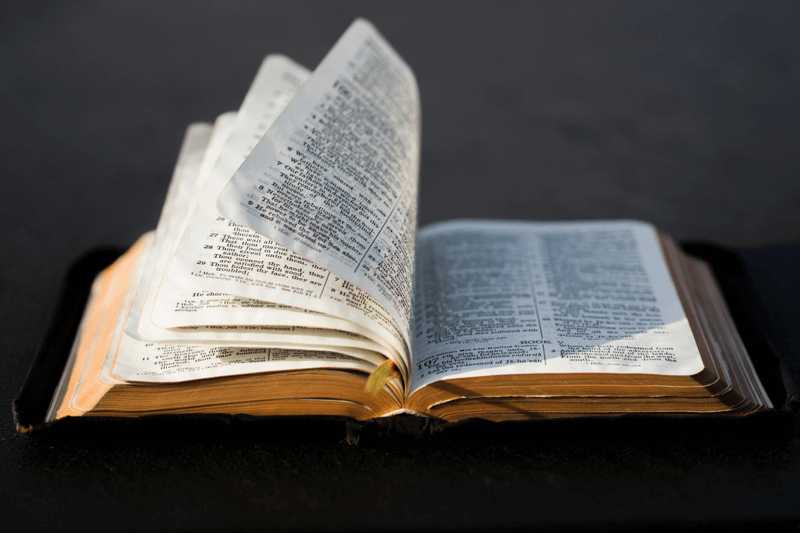
The Transforming Power of the Word
Read 2 Kings 22:3–20. What causes King Josiah to tear his clothes? How does his discovery change not only him but also the entire nation of Judah?
In 621 b.c., when Josiah was about 25 years old, Hilkiah, the high priest, discovered “the book of the law,” which may have been the first five books of Moses or, specifically, the book of Deuteronomy. During the reign of his father Amon, and his most wicked grandfather Manasseh, this scroll had been lost in the midst of the worship of Baal, Asherah, and “all the host of heaven” (2 Kings 21:3–9). As Josiah hears the conditions of the covenant, he tears his clothes in utter distress, for he realizes how far he and his people have come from worshiping the true God. He immediately begins a reformation throughout the land, tearing down the high places and destroying images to foreign gods. When he is finished, there is only one place left to worship in Judah: the temple of God in Jerusalem. The discovery of the Word of God leads to conviction, repentance, and the power to change. This change begins with Josiah and eventually spreads to the rest of Judah.
How does the Bible assure us that it has the power to change our lives and show us the way to salvation? Read John 16:13, John 17:17, Hebrews 4:12, and Romans 12:2.
One of the most powerful testimonies of the power of the Bible is the changed life of a person. It is the Word that cuts through human sin and depravity and reveals our true human nature and our need for a Savior.
Such a unique book as the Bible, constituted in history, imbued with prophecy, and with the power to transform the life, also must be interpreted in a unique way. It cannot be interpreted like any other book, for the living Word of God must be understood in the light of a living Christ who promised to send His Spirit to lead us “into all truth” (John 16:13). The Bible, then, as a revelation of God’s truth, must contain its own internal principles of interpretation. These principles can be found in studying how the writers of Scripture used Scripture and were guided by it as they allowed Scripture to interpret itself.
Additional Reading: Selected Quotes from Ellen G. White
"Josiah was deeply stirred as he heard read for the first time the exhortations and warnings recorded in this ancient manuscript. Never before had he realized so fully the plainness with which God had set before Israel “life and death, blessing and cursing” (Deuteronomy 30:19): and how repeatedly they had been urged to choose the way of life, that they might become a praise in the earth, a blessing to all nations. “Be strong and of a good courage, fear not, nor be afraid,” Israel had been exhorted through Moses; “for the Lord thy God. He it is that doth go with thee; He will not fail thee, not forsake thee.” Deuteronomy 31:6. {PK 393.2}
These and similar passages revealed to Josiah God’s love for His people and His abhorrence of sin. As the king read the prophecies of swift judgment upon those who should persist in rebellion, he trembled for the future. {PK 396.2}"
Josiah the king... rent his garments, and bade the men in holy office to inquire of the Lord for him, and for his people; for they had departed from the statutes of the Lord. He called together all the men of Israel, and the words of the book were read in the hearing of the congregation. The sin of the rulers and the people was pointed out, and the king stood up before them, and confessed his transgression. He manifested his repentance, and made a covenant to keep the statutes of the Lord with his whole heart. Josiah did not rest until the people did all they could to return from their backsliding, and serve the living God. {RC 57.2}
The truths of the Word of God are the utterances of the Most High. He who makes these truths a part of his life becomes in every sense a new creature. He is not given new mental powers, but the darkness that through ignorance and sin has clouded the understanding is removed. The words, “A new heart also will I give you,” mean, “A new mind will I give you.” A change of heart is always attended by a clear conviction of Christian duty, an understanding of truth. He who gives the Scriptures close, prayerful attention will gain clear comprehension and sound judgment, as if in turning to God he had reached a higher plane of intelligence. {ML 24.2}
The knowledge of God is as high as the heaven, as broad as the earth.... Only those who read the Scriptures as the voice of God speaking to them are the true learners. They tremble at the Word of God; for to them it is a living reality. They study, they search for the hidden treasure. They open the understanding and heart to receive, and they pray for heavenly grace, that they may obtain a preparation for the future, immortal life. As the heavenly torch is placed in his hand, man sees his own frailty, his infirmity, his hopelessness in looking to himself for righteousness. He sees that in himself there is nothing to recommend him to God. He prays for the Holy Spirit, the representative of Christ, to be his constant guide, to lead him into all truth.... All knowledge gained in this life of probation which will fit us to be companions of the saints in light is true education. It brings blessings to ourselves and others in this life, and will secure to us the future, immortal life, with all its imperishable riches. {SD 125.4}