

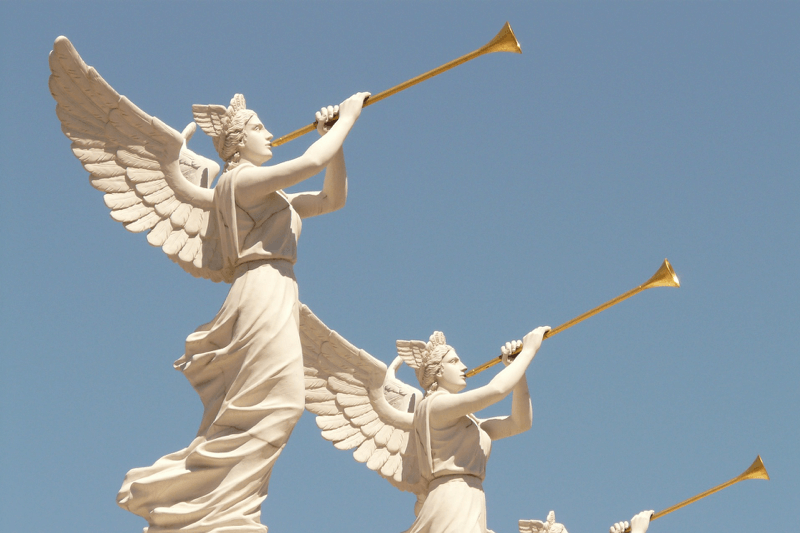
The Meaning of the Trumpets
In portraying God’s interventions on behalf of His people, Revelation uses the imagery of trumpets in the Old Testament. Trumpets were an important part of the daily life of ancient Israel (see Num. 10:8–10 and 2 Chron. 13:14, 15). Their sound reminded people of the worship in the temple; trumpets also were blown in battle, at harvest time, and during festivals.
Blowing trumpets went hand in hand with prayer. During worship in the temple or during the festivals, the trumpets “reminded” God of His covenant with His people. They also reminded people to be ready for the “day of the Lord” (Joel 2:1). During battle, the trumpet sound gave key instruction and warnings and called upon God to save His people. This concept is the backdrop for the trumpets in Revelation.
Read Revelation 8:13 and Revelation 9:4, 20, 21. Who are the objects of the judgments of the seven trumpets?
The events triggered by the trumpets in Revelation denote God’s intervention in history in response to the prayers of His people. While the seals concern primarily those who profess to be God’s people, the trumpets herald judgments against the inhabitants of the earth (Rev. 8:13). At the same time, they are warnings for those who dwell on the earth to bring them to repentance before it is too late.
The seven trumpets cover the course of events from John’s time until the conclusion of this earth’s history (Rev. 11:15–18). They are blown while intercession goes on in heaven (Rev. 8:3–6) and the gospel is being preached on earth (Rev. 10:8–11:14). The judgments of the trumpets are partial; they affect only one third of creation. The seventh trumpet announces that the time has arrived for God to assume His rightful rule. The seven trumpets apply approximately to the same periods covered by the seven churches and the seven seals:
(A) The first two trumpets herald judgments upon the nations that crucified Christ and persecuted the early church: rebellious Jerusalem and the Roman Empire.
(B) The third and fourth trumpets portray heaven’s judgment against the apostasy of the Christian church in the medieval period.
(C) The fifth and sixth trumpets describe the warring factions in the religious world during the late medieval and post-Reformation periods. These periods are characterized by increasing demonic activity that ultimately draws the world into the battle of Armageddon.
No question, history is bloody and full of pain and sorrow. How should this sad reality help us realize just how wonderful what we have been promised through Jesus really is?
Additional Reading: Notes from Ellen G. White
Very soon after leaving Egypt [the Israelites] were organized and most thoroughly disciplined. . . . The Lord did not leave His holy tabernacle to be borne indiscriminately by any tribe that might choose. . . . The Levites were designated by the Lord as the tribe in the midst of whom the sacred ark was to be borne, Moses and Aaron marching just in front of the ark, and the sons of Aaron following near them, each bearing trumpets. They were to receive directions from Moses, which they were to signify to the people by speaking through the trumpets. These trumpets gave special sounds which the people understood, and directed their movements accordingly.
A special signal was first given by the trumpeters to call the attention of the people; then all were to be attentive and obey the certain sound of the trumpets. There was no confusion of sound in the voices of the trumpets, therefore there was no excuse for confusion in movements. The head officer of each company gave definite directions in regard to the movements they were required to make, and none who gave attention were left in ignorance of what they were to do.—Testimonies for the Church, vol. 1, pp. 650, 651.
By reflecting the image of Jesus Christ, by the beauty and holiness of their characters, by their continual self-denial and their separation from all idols, large or small, [God’s people] reveal that they have learned in the school of Christ. They are continually catching the spirit of love and forbearance, meekness, and gentleness, and they stand as representatives of Christ, a spectacle to the world, to angels, and to men. . . .
They are to stand as the strong fortress of truth, their light shining far in the moral darkness of the world. The Lord has a message for the watchmen on the walls of Zion to bear. The trumpet is to give no uncertain sound.—Our High Calling, p. 247.
There is a work to be done among the churches of Seventh-day Adventists that has not yet been done. . . . Let all humble themselves before God, asking for grace and wisdom, that they may see wherein they have violated His holy law. Unless His Spirit enlightens them, they will never know, even though it is set before them by their brethren. Those who refuse to come into right relation to God, who will not obey the rules of His government, do not bear His mark. . . .
The Lord is merciful. He does not chastise His people because He hates them, but because He hates the sins they are committing. He must chastise them, that they may return to their loyalty. He designs their punishment to be a warning to them and to others. No one need walk in darkness. No one need say, “Specify to me the precise wrongs of which I am guilty.” To those who say this, I give the word of the Lord: “Search prayerfully, and you will know.”—The Upward Look, p. 240.