

Christ Alone . . . Grace Alone
Read Ephesians 2:8, 9; Romans 3:23, 24; Romans 6:23; and Romans 5:8–10. What do these verses teach about the plan of salvation?
God has provided salvation as a gift. His Holy Spirit leads us to accept by faith what Christ has so freely provided through His death on Calvary’s cross. Jesus, the divine Son of God, offered His perfect life to atone for our sins.
Divine justice demands perfect obedience. Christ’s perfect life stands in place of our imperfect lives. The divine law we have broken condemns us to eternal death. The Bible is clear. Through our sinful choices, we have “fallen short” of God’s ideal for our lives. We have sinned. Left to ourselves, we cannot meet the just, righteous demands of a holy God. As a result, we deserve eternal death. But there is good news. The apostle Paul assures us, “For the wages of sin is death, but the gift of God is eternal life in Christ Jesus our Lord” (Rom. 6:23, NKJV). It is a gift, undeserved; if it were by works, we would earn it, and if there is any one truth that shines out of the gospel, it is that we cannot earn salvation.
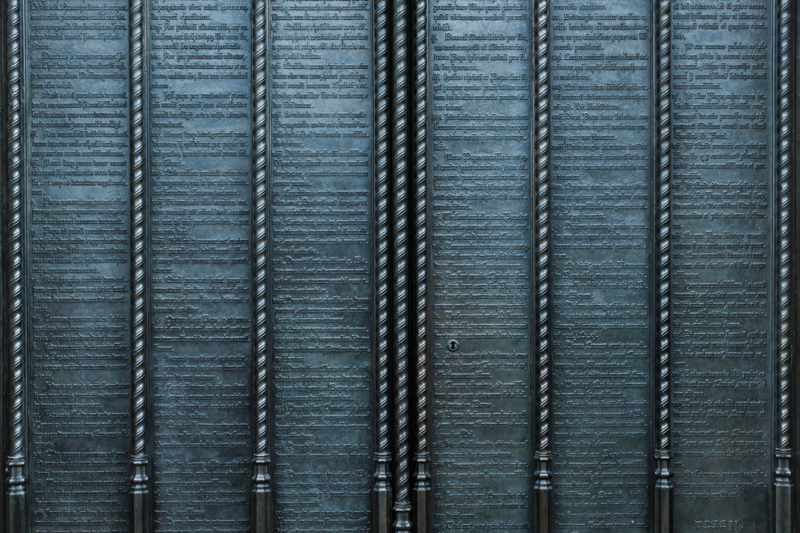
Martin Luther and the Protestant Reformers discovered Christ and Christ alone as their source of salvation. It was then that Luther began to preach the message of Christ’s saving grace. Crowds flocked to hear his heartfelt, life-changing messages. His words were like a drink of cold water in the barren desert of their lives. The people were shackled by the traditions of the medieval church and kept in bondage with centuries-old rituals that provided no spiritual life. Luther’s biblical messages touched hearts, and lives were changed.
As Luther read the New Testament, he was overwhelmed with the goodness of God. He was amazed at God’s desire to save all humanity. The popular view taught by church leaders at the time was salvation as partly a human work and partly God’s work. Luther discovered that Christ’s death on the cross was all-sufficient for all humanity.
“Christ was treated as we deserve, that we might be treated as He deserves. He was condemned for our sins, in which He had no share, that we might be justified by His righteousness, in which we had no share. He suffered the death which was ours, that we might receive the life which was His.”—Ellen G. White, The Desire of Ages, p. 25.
What a powerful and wonderfully written summary of the gospel, that we could be justified by a righteousness “in which we had no share.” What a promise!
If salvation is the work of God in Christ, what role do our good works play in the Christian life? How can we affirm the importance of good works in our experience without making them the foundation of our hope?
Supplemental EGW Notes
In the Garden of Gethsemane Christ suffered in man’s stead, and the human nature of the Son of God staggered under the terrible horror of the guilt of sin, until from His pale and quivering lips was forced the agonizing cry, “O my Father, if it be possible, let this cup pass from me:” but if there is no other way by which the salvation of fallen man may be accomplished, then “not as I will, but as thou wilt.” Human nature would then and there have died under the horror of the sense of sin, had not an angel from heaven strengthened Him to bear the agony.
The power that inflicted retributive justice upon man’s substitute and surety, was the power that sustained and upheld the suffering One under the tremendous weight of wrath that would have fallen upon a sinful world. Christ was suffering the death that was pronounced upon the transgressors of God’s law.—Ellen G. White Comments, in The Seventh-day Adventist Bible Commentary, vol. 5, p. 1103.
The gift of God is eternal life. The Lord desires all who receive His grace to trust entirely in Him. He calls upon us to exercise pure, simple faith, trusting in Him, without a question as to what recompense we shall receive. We are to work heartily in His service, showing that we have perfect confidence that He will judge righteously.
In the account of the judgment scene, when the reward is given to the righteous, and sentence is passed on the wicked, the righteous are represented as wondering what they have done that they should receive such reward. But they cherished an abiding faith in Christ. They were imbued with His Spirit, and, without conscious effort, they performed for Christ, in the person of His saints, those services that bring a sure reward. But their motive in working was not to receive compensation. They regarded it as the highest honor to be allowed to work as Christ worked. What they did was done from love to Christ and to their fellowmen, and He who has identified Himself with suffering humanity accredited these acts of compassion and love as though done to Himself.—Lift Him Up, p. 343.
By the wedding garment . . . is represented the pure, spotless character which Christ’s true followers will possess. To the church it is given “that she should be arrayed in fine linen, clean and white,” “not having spot, or wrinkle, or any such thing.” The fine linen, says the Scripture, “is the righteousness of saints.” It is the righteousness of Christ, His own unblemished character, that through faith is imparted to all who receive Him as their personal Saviour. . . . This covering, the robe of His own righteousness, Christ will put upon every repenting, believing soul.—Christ’s Object Lessons, p. 311.
The above quotations are taken from Ellen G. White Notes for the Sabbath School Lessons, published by Pacific Press Publishing Association. Used by permission.