

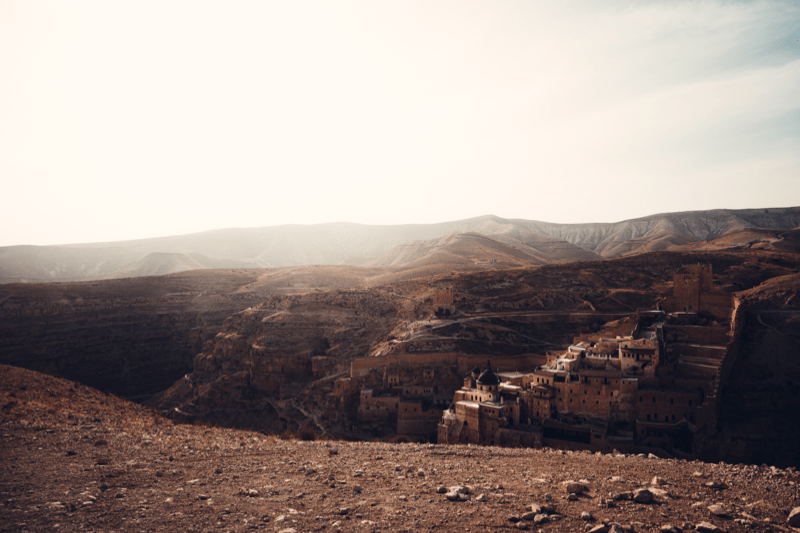
Kadesh Barnea
A specter has been haunting the early parts of the book of Deuteronomy, the specter of Kadesh Barnea. This unfortunate story, as we have seen, set the immediate background for the book of Deuteronomy, and it’s worth taking a closer look at it.
Read Numbers 14. How did the people react to the report of the spies, and what were the results of their reaction? (See also Deut. 1:20–46.)
We can derive many important lessons from this story, but one important lesson, which will appear again in the book, can be found in Numbers 14, as well.
Read Numbers 14:11–20. Though we see Moses again in the role of intercessor, what is significant about his line of reasoning with the Lord regarding why the Lord should not destroy them?
Think about what Moses was saying to God. If You do this, look at how You will appear in the eyes of the Egyptians and the other nations in the area. This point is important because, ultimately, everything that God had wanted to do with Israel wasn’t just for the sake of Israel; it also was for humanity as a whole. The nation of Israel was to be a light to the world, a witness to the ancients about the love and power and salvation found in the true God and not in the worthless idols that these people had worshiped.
However, as Moses said, If You wipe this people out, then what? The nations will say: “Because the Lord was not able to bring this people to the land which He swore to give them, therefore He killed them in the wilderness” (Num. 14:16, NKJV).
In other words, what we see here is a theme found all through the Bible: the idea that God is to be glorified in His people—that the glory and goodness and love and power of God are to be revealed in His church, through what He does through His people. Of course, His people don’t always make it easy for Him to do this, but ultimately God will be glorified through His people’s actions on earth.
Read Ephesians 3:10. What is Paul saying here, and how does this happen? How is the “manifold wisdom” of God made manifest to the cosmos? What role, if any, do we have as individuals in bringing this about?
Supplemental EGW Notes
After [the spies] had spoken of the fertility of the land, all but two spoke very discouragingly of their ability to possess it. They said that the people were very strong that dwelt in the land, and the cities were surrounded with great and high walls, and, more than all this, they saw the children of the giant Anak there. They then described how the people were situated around Canaan and expressed the fear that it would be impossible for them ever to possess this land.
As the people listened to this report, they gave vent to their disappointment in bitter reproaches and wailing. They did not wait to reflect and reason that God, who had brought them out thus far, would certainly give them the land. They left God out of the question. They acted as though in taking the city of Jericho, the key to the land of Canaan, they must depend solely on the power of arms. God had declared that He would give them the country, and they should have fully trusted Him to fulfill His word. But their unsubdued hearts were not in harmony with His plans. They did not reflect how wonderfully He had wrought in their behalf, bringing them out of their Egyptian bondage, cutting a path for them through the waters of the sea, and destroying the pursuing host of Pharaoh. In their unbelief they were limiting the work of God and distrusting the hand that had hitherto safely guided them.
In this instance they repeated their former error of murmuring against Moses and Aaron. “This, then, is the end of all our high hopes,” said they. “This is the land we have traveled all the way from Egypt to possess.” They blamed their leaders for bringing trouble upon Israel and again charged them with deceiving the people and leading them astray.—Testimonies for the Church, vol. 4, p. 148.
God did not design that His people, Israel, should wander forty years in the wilderness. He promised to lead them directly to the land of Canaan, and establish them there a holy, healthy, happy people. But those to whom it was first preached, went not in “because of unbelief” (Hebrews 3:19). Their hearts were filled with murmuring, rebellion, and hatred, and He could not fulfill His covenant with them.
For forty years did unbelief, murmuring, and rebellion shut out ancient Israel from the land of Canaan. The same sins have delayed the entrance of modern Israel into the heavenly Canaan. In neither case were the promises of God at fault. It is the unbelief, the worldliness, unconsecration, and strife among the Lord’s professed people that have kept us in this world of sin and sorrow so many years.—Selected Messages, book 1, pp. 68, 69.
The purpose which God seeks to accomplish through His people today is the same that He desired to accomplish through Israel when He brought them forth out of Egypt. By beholding the goodness, the mercy, the justice, and the love of God revealed in the church, the world is to have a representation of His character. . . .
. . . Not to this world only but to the universe are we to make manifest the principles of His kingdom.—Testimonies for the Church, vol. 6, pp. 12, 13.
The above quotations are taken from Ellen G. White Notes for the Sabbath School Lessons, published by Pacific Press Publishing Association. Used by permission.