

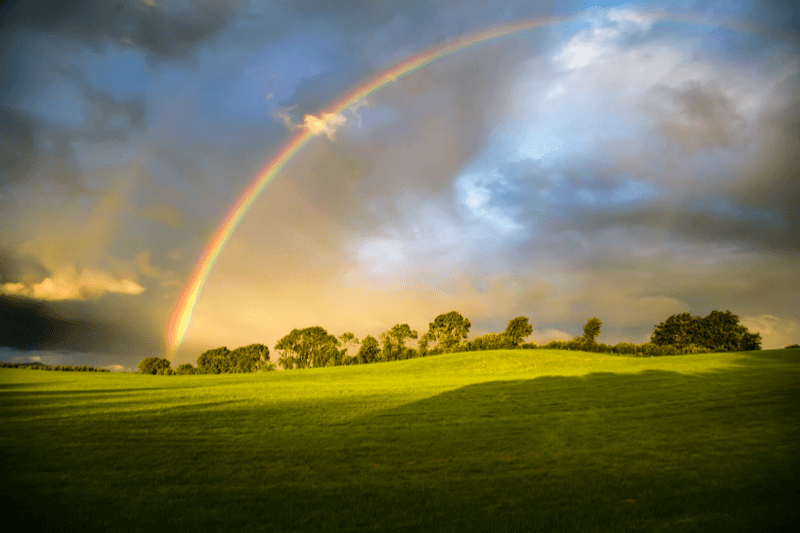
Sign Of The Rainbow
“And God said, ‘This is the sign of the covenant which I make between me and you and every living creature that is with you, for all future generations: I set my bow in the cloud, and it shall be a sign of the covenant between me and the earth’ ” (Gen. 9:12, 13, RSV).
Few natural phenomena are more beautiful than the rainbow. Who does not remember as a child one’s first fascination and wonder as those amazing bars of light bent across the sky like some sort of beckoning, mystical portal into the heavens (or maybe merely a clown’s belt)? Even as adults, our breath can be taken away by the sight of those outrageous colors in the clouds. No wonder that even today the rainbow is used as a symbol for so many things: from political organizations to cults to rock bands to travel agencies (look up the word “rainbow” on the Web and see). Obviously, those beautiful bands of color still touch chords in our hearts and minds.
Of course, that was God’s whole point.
Why did the Lord say the rainbow would symbolize? Gen. 9:12–17.
The Lord said He would use the rainbow as a sign of “my covenant” (Gen. 9:15). How interesting that He would use the word covenant here, for, in this case, the covenant differs from how it is used elsewhere. In contrast to the covenant with Abraham or the Sinai covenant, there is no specific obligation expressed on the part of those who would benefit from the covenant (even Noah). God’s words here are to all people, to “ ‘every living creature of all flesh’ ” (Gen. 9:15, RSV) for “ ‘all future generations’ ” (Gen. 9:12, RSV). God’s words are universal, all-encompassing, regardless of whether anyone chooses to obey the Lord or not. In this sense the concept of covenant is not used as it is elsewhere in the Bible when talking about the relationship between God and humans.
In what sense does this covenant also reveal God’s grace? Who initiated this covenant? Who is the ultimate benefactor?
Though the covenant, as expressed here, does not come with specific obligations on our part (God’s part, of course, is never to destroy the world with a flood), how could our knowledge of what the rainbow symbolizes influence us to live in obedience to the Lord? In short, are there some implied obligations on our part when we look up into the sky and see the rainbow? Think of the whole context in which the rainbow came and the lessons we can learn from that account.
Additional Reading: Selected Quotes from Ellen G. White
In the joy of their release Noah did not forget Him by whose gracious care they had been preserved. His first act after leaving the ark was to build an altar and offer from every kind of clean beast and fowl a sacrifice, thus manifesting his gratitude to God for deliverance and his faith in Christ, the great sacrifice. This offering was pleasing to the Lord; and a blessing resulted, not only to the patriarch and his family, but to all who should live upon the earth. “The Lord smelled a sweet savor; and the Lord said in His heart, I will not again curse the ground any more for man’s sake. While the earth remaineth, seedtime and harvest, and cold and heat, and summer and winter, and day and night shall not cease.”
Here was a lesson for all succeeding generations. Noah had come forth upon a desolate earth, but before preparing a house for himself he built an altar to God. His stock of cattle was small, and had been preserved at great expense; yet he cheerfully gave a part to the Lord as an acknowledgment that all was His. In like manner it should be our first care to render our freewill offerings to God. Every manifestation of His mercy and love toward us should be gratefully acknowledged, both by acts of devotion and by gifts to His cause.—Patriarchs and Prophets, p. 105.
What compassion for erring man, to place the beautiful, variegated rainbow in the clouds, a token of the covenant of the great God with man! This rainbow was to evidence the fact to all generations that God destroyed the inhabitants of the earth by a flood, because of their great wickedness. It was his design that as the children of after generations should see the bow in the cloud, and should inquire the reason of this glorious circle that compasseth the earth, that their parents could explain to them the destruction of the old world by a flood, because the people gave themselves up to all manner of wickedness, and that the hands of the Most High had bended the bow, and placed it in the clouds, as a token that he would never bring again a flood of waters on the earth.
This symbol in the clouds was to confirm the belief of all, and establish their confidence in God, for it was a token of divine mercy and goodness to man. That although God had been provoked to destroy the earth by the flood, yet his mercy still encompasseth the earth. God says, when he looketh upon the bow in the cloud he will remember. He would not have us understand that he would ever forget; but he speaks to man in his own language, that man may better understand him.—Spiritual Gifts, vol. 3, p. 74.
The words and promises of God are the only foundation of our faith. Take the word of God as truth, as a living, speaking voice to you, and obey faithfully every requirement. God is faithful, who hath promised. . . . Our blessings are limited by the weakness of our faith. God is not unwilling to bestow; He is a reservoir of power.—Counsels on Sabbath School Work, p. 72.