

Nehemiah Takes Action (444 b.c.)
Read Nehemiah 4. What did the Jews do under Nehemiah’s leadership to stand up to opposition? Why was it important for them to prepare themselves to fight, rather than just do nothing, believing that God would protect them?
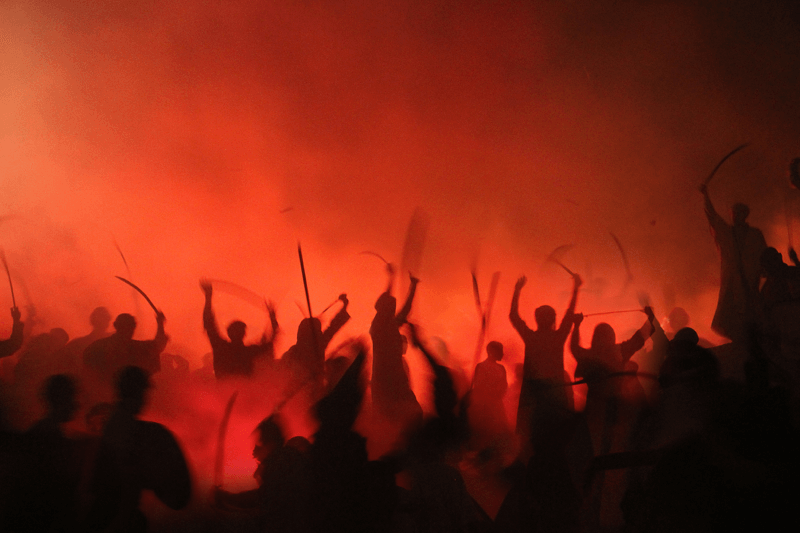
After starts and stops, the people began working again. The Jews prayed, and then Nehemiah set up an active guard. The people rotated through shifts during the day and nighttime in order to be prepared for any looming attacks. Nehemiah also organized the people around the wall with weapons so that each family was ready to fight. Additionally, he divided his servants into two groups, with one working and the other holding weapons. There also were special provisions for all those who worked on the wall, as they were closest to the danger. Each one of the builders held a sword with one hand and with the other added bricks or stones and mortar to the wall. They were prepared to face the opposition. They did their part; God did the rest. Nehemiah’s faith in God’s protection is inspiring. However, he didn’t sit on the couch and expect God to do everything. They prepared by doing the best of their abilities.
The two passages “Do not be afraid of them. Remember the Lord, great and awesome, and fight for your brethren, your sons, your daughters, your wives, and your houses” (see Neh. 4:13, 14, NKJV) and “Our God will fight for us” (see Neh. 4:19, 20, NKJV) are some of the most inspirational statements found in the Bible.
The Jews could have stopped building once again because of the persistent opposition, but, this time, instead of being overcome by fear, they held on to the promise that God would fight for them. When we encounter opposition to the name of God, to our beliefs, or to what God calls us to do, we should remember that “God will fight for us.” In the end, the Jews realized that the Lord was behind what they were doing, and this gave them the courage to press on ahead.
Why is it so important to know that what you are doing is God’s will? Thus, an important question to ask is: How do I know if what I am doing is God’s will?
Additional Reading: Selected Quotes from Ellen G. White
The restoration of the defenses of Jerusalem did not go forward unhindered. Satan was working to stir up opposition, and bring discouragement. . . . But taunts and ridicule, opposition and threats, seemed only to inspire Nehemiah with firmer determination and to arouse him to greater watchfulness. He recognized the dangers that must be met in this warfare with their enemies, but his courage was undaunted. “We made our prayer unto our God,” he declares, “and set a watch against them day and night.”
Beside Nehemiah stood a trumpeter, and on different parts of the wall were stationed priests bearing the sacred trumpets. The people were scattered in their labors; but on the approach of danger at any point, a signal was given for them to repair thither without delay. “So we labored in the work,” Nehemiah says, “and half of them held the spears from the rising of the morning till the stars appeared.” . . . Nehemiah and his companions did not shrink from hardship or trying service. Neither by day nor night, not even during the short time given to sleep, did they put off their clothing, or lay aside their armor.—Conflict and Courage, p. 266.
Like Nehemiah, God’s people are neither to fear nor to despise their enemies. Putting their trust in God, they are to go steadily forward, doing His work with unselfishness, and committing to His providence the cause for which they stand.
Amidst great discouragement, Nehemiah made God his trust, his sure defense. And He who was the support of His servant then has been the dependence of His people in every age. In every crisis His people may confidently declare, “If God be for us, who can be against us?” Romans 8:31. However craftily the plots of Satan and his agents may be laid, God can detect them, and bring to nought all their counsels. The response of faith today will be the response made by Nehemiah, “Our God shall fight for us;” for God is in the work, and no man can prevent its ultimate success.—Prophets and Kings, p. 645.
By study of the Scriptures and earnest prayer seek to obtain clear conceptions of your duty, and then faithfully perform it. It is essential that you cultivate faithfulness in little things, and in so doing you will acquire habits of integrity in greater responsibilities. . . . The mind needs to be trained by daily tests, that it may acquire power to stand in any difficult position. In the days of trial and of peril you will need to be fortified to stand firmly for the right, independent of every opposing influence.
God is willing to do much for you, if you will only feel your need of Him. Jesus loves you. Ever seek to walk in the light of God’s wisdom, and through all the changing scenes of life do not rest unless you know that your will is in harmony with the will of your Creator.—Testimonies for the Church, vol. 4, p. 561.