

A Riot in the Amphitheater
Read Acts 19:21–20:1. What lessons can we draw from this story?
Paul’s witness in the large, sophisticated city of Ephesus was so effective that it impacted an important economic engine for the city, tourism focused on the Temple of Artemis. And what a temple it was! This magnificent structure was composed partly of 127 pillars, each 60 feet high, of Parian marble, a pure-white, flawless marble highly prized for sculptures. Thirty-six of these pillars were sculpted and overlaid with gold, earning the temple its reputation as one of the Seven Wonders of the Ancient World.
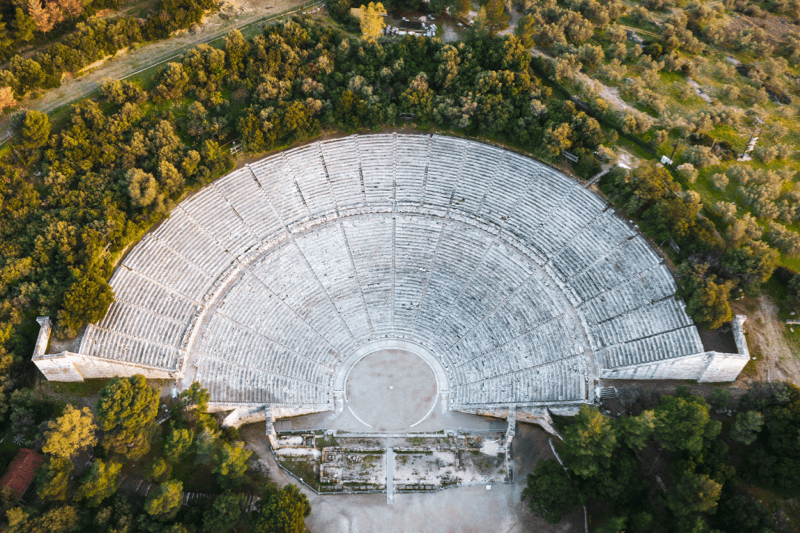
Concerned that Paul’s anti-idolatry rhetoric was draining financial support from the temple (Acts 19:27), Demetrius the silversmith whipped his fellow craftsmen into a frenzy. A rapidly expanding and highly energized crowd swept from the marketplace into the large amphitheater, which seated some twenty-five thousand people. There the commotion continued, featuring two continuous hours of shouting “ ‘Great is Artemis of the Ephesians!’ ” (Acts 19:34, ESV). After the crowd is dispersed by the town clerk, Paul meets with the believers and leaves the city.
At the end of his third missionary journey, Paul meets with elders of the Ephesian church. How would you summarize Paul’s concerns? See Acts 20:17–38.
A tentative chronology of Paul’s relationship to Ephesus:
* AD 52: Paul’s initial, brief visit to Ephesus (Acts 18:18–21).
* AD 53–56: Paul’s three-year ministry in Ephesus (Acts 19:1–20:1). He composes 1 Corinthians near the end of his stay there (1 Cor. 16:5–9).
* AD 57: While at Miletus, Paul meets with the elders from Ephesus (Acts 20:17–38).
* AD 62: Paul composes his letter to the Ephesians, probably from confinement in Rome.
“Therefore watch, and remember that for three years I did not cease to warn everyone night and day with tears,” said Paul (Acts 20:31, NKJV). What do you think Paul would warn our church about today, and why?
Supplemental EGW Notes
In his speech Demetrius had said, “This our craft is in danger.” These words reveal the real cause of the tumult at Ephesus, and also the cause of much of the persecution which followed the apostles in their work. Demetrius and his fellow craftsmen saw that by the teaching and spread of the gospel the business of image making was endangered. The income of pagan priests and artisans was at stake, and for this reason they aroused against Paul the most bitter opposition.
The decision of the recorder and of others holding honorable offices in the city had set Paul before the people as one innocent of any unlawful act. This was another triumph of Christianity over error and superstition. God had raised up a great magistrate to vindicate His apostle and hold the tumultuous mob in check. Paul’s heart was filled with gratitude to God that his life had been preserved and that Christianity had not been brought into disrepute by the tumult at Ephesus.—The Acts of the Apostles, p. 295.
Paul, as well as laboring publicly, went from house to house preaching repentance toward God and faith toward our Lord Jesus Christ. He met with men at their homes, and besought them with tears, declaring unto them the whole counsel of God. Jesus came in personal contact with men. He did not stand aloof and apart from those who needed His help. We must come close to the hearts of those who need our ministry. We must open the Bible to the understanding, present the claims of God’s law, read the promises to the hesitating, urge the backward, arouse the careless, strengthen the weak.
Do not neglect speaking to your neighbors, and doing them all the kindness in your power. We need to seek for the spirit that constrained the apostle Paul to go from house to house, pleading with tears, and teaching “repentance toward God, and faith toward our Lord Jesus Christ.”—Reflecting Christ, p. 245.
There are a thousand temptations in disguise prepared for those who have the light of truth; and the only safety for any of us is in receiving no new doctrine, no new interpretation of the Scriptures, without first submitting it to brethren of experience. Lay it before them in a humble, teachable spirit, with earnest prayer; and if they see no light in it, yield to their judgment.
Satan is constantly at work; but few have any idea of his activity and subtlety. The people of God must be prepared to withstand the wily foe. It is this resistance that Satan dreads. He knows better than we do the limit of his power and how easily he can be overcome if we resist and face him. Through divine strength the weakest saint is more than a match for him and all his angels, and if brought to the test he would be able to prove his superior power. Therefore Satan’s step is noiseless, his movements stealthy, and his batteries masked. He does not venture to show himself openly, lest he arouse the Christian’s dormant energies and send him to God in prayer.—Maranatha, p. 60.
The above quotations are taken from Ellen G. White Notes for the Sabbath School Lessons, published by Pacific Press Publishing Association. Used by permission.